Table of Contents
ToggleSetting up a dedicated home theater transforms movie nights from routine to memorable. Panasonic has earned its reputation in the audio-visual space by delivering systems that balance performance with practical installation, something that matters when you’re threading speaker wire through walls or drilling into studs. Whether upgrading from a soundbar or building a setup from scratch, understanding what Panasonic offers and how to install it properly makes the difference between passable sound and true cinema-quality audio. This guide walks through model selection, installation steps, room optimization, and the upkeep that keeps your investment sounding sharp for years.
Key Takeaways
- Panasonic home theater systems offer practical, DIY-friendly designs with clear color-coded wiring, straightforward documentation, and integration with existing Panasonic display hardware for simplified installation.
- Proper speaker placement (front speakers at ear level angled 22-30 degrees, surround speakers at 90-110 degrees 1-2 feet above ear level) and attention to polarity prevents phase issues and maximizes dialogue clarity.
- Room optimization techniques—including subwoofer placement using the crawl method, acoustic treatments on first-reflection points, and wireless rear speaker kits—adapt Panasonic systems to spaces ranging from under 200 to over 350 square feet.
- Auto-calibration microphones and HDMI 2.1 support with eARC future-proof most Panasonic models for 4K gaming and Dolby Atmos passthrough without costly receiver upgrades.
- Regular maintenance—dust removal every three months, annual wire connection checks, and firmware updates—keeps your system sounding optimal and prevents thermal issues or connectivity problems.
- Smart home integration via HDMI-CEC, voice control, and network-based automation scenes simplifies multi-device control, though dedicated universal remotes provide more reliable, cloud-independent operation.
Why Choose a Panasonic Home Theater System for Your Living Space
Panasonic systems appeal to DIYers who want solid engineering without the steep learning curve of audiophile-grade components. The brand’s receiver units typically include clear labeling on terminals, which matters when you’re matching impedance or running 5.1 or 7.1 speaker configurations.
Most Panasonic models ship with color-coded speaker wire and straightforward connection diagrams. This isn’t trivial, mismatched polarity or loose banana plugs cause phase issues that muddy dialogue. Panasonic’s documentation usually specifies wire gauge (14 AWG for runs under 50 feet is standard) and terminal torque, reducing guesswork.
Another practical advantage: Panasonic systems often integrate with existing Blu-ray players and TVs from the same manufacturer, minimizing HDMI handshake issues. If someone’s already running Panasonic display hardware, sticking with the ecosystem simplifies troubleshooting. The brand’s mid-range receivers support HDMI 2.1 and eARC, which future-proofs the setup for 4K/120Hz gaming or Dolby Atmos passthrough without needing an AVR upgrade in two years.
Top Panasonic Home Theater Models Worth Considering
Panasonic’s current lineup spans all-in-one systems and component-based setups. The SC-HTB700 soundbar system works for renters or anyone avoiding in-wall speaker runs, it’s a 3.1 channel unit with a wireless subwoofer that delivers respectable low-end without drilling through floor joists. It won’t match discrete surround speakers, but for a living room under 250 square feet, it covers dialogue clarity and enough bass for action sequences.
For proper surround sound, the SC-BTT series (if still available in your market) offers Blu-ray-integrated receivers with five satellite speakers and a powered sub. These systems handle the receiver, disc playback, and amplification in one chassis, useful for simplifying component count but limiting future expansion. You can’t swap the receiver independently if HDMI standards change.
Component buyers looking at separates should verify power output. A receiver rated at 100 watts per channel into 8 ohms handles most home theater speakers without clipping at reference volume. Lower-wattage units (50-75W) work fine in smaller rooms but struggle to drive floor-standing speakers in spaces over 300 square feet.
Key Features to Look for in Panasonic Systems
HDMI ports matter more than most spec sheets suggest. Look for at least four HDMI inputs if connecting a game console, streaming box, Blu-ray player, and cable box. HDMI 2.1 support ensures compatibility with PS5/Xbox Series X gaming at full resolution.
Room calibration microphones come standard on many Panasonic receivers. The system runs test tones, measures speaker distance and output, then adjusts EQ and delay. This auto-calibration gets you 80% of the way to optimized sound without manual SPL meter readings, though manual tweaking still helps in acoustically challenging rooms.
Wireless rear speaker kits are available for select models. These eliminate the need to run speaker wire under baseboards or through attic spaces, a real time-saver in finished rooms. Trade-off: wireless kits add latency (usually under 20ms, imperceptible to most listeners) and require separate power outlets near rear speaker locations.
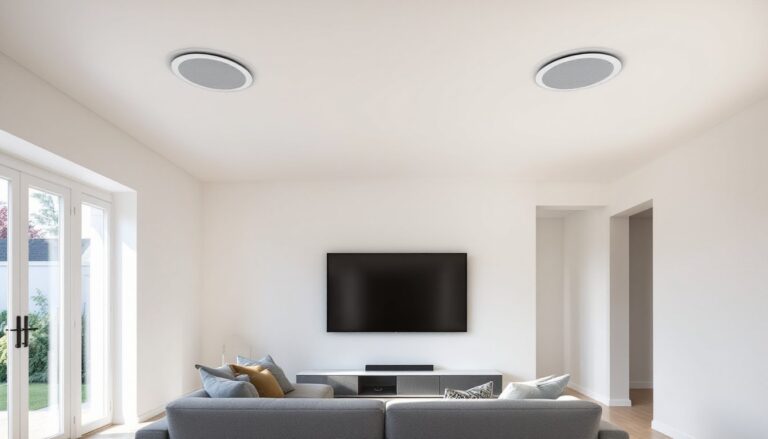
Dolby Atmos and DTS:X support appears on higher-tier models. These formats add height channels for overhead sound effects. Implementing them properly requires ceiling-mounted speakers or upfiring modules, which complicates installation. If the ceiling is drywall over 16-inch on-center joists, mounting is straightforward. Popcorn ceilings or plaster-and-lath construction adds difficulty.
Installing Your Panasonic Home Theater: A DIY-Friendly Approach
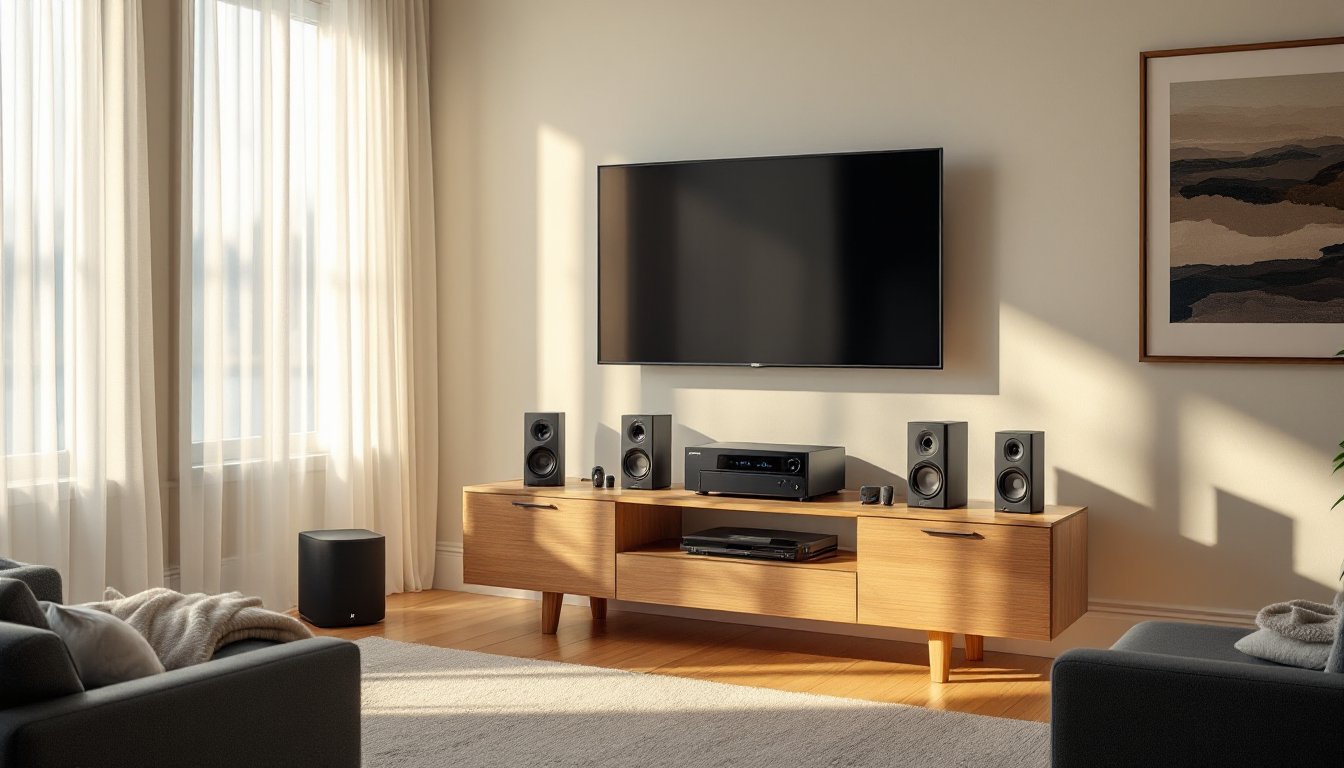
Start by mapping speaker placement on paper. Front left and right speakers flank the TV at ear height when seated, angled 22-30 degrees toward the main listening position. The center channel sits directly above or below the screen, this speaker handles 60% of a film’s dialogue, so don’t mount it inside a cabinet where fabric grille cloth muffles highs.
Surround speakers go 90-110 degrees to the sides of the seating area, 1-2 feet above ear level. Wall-mounting brackets work, but toggle bolts or #8 wood screws into studs provide the secure attachment. Drywall anchors alone won’t reliably hold a 10-pound speaker over time, especially if someone bumps it.
Running speaker wire requires planning. For in-wall runs, use CL2 or CL3-rated wire, these meet fire safety codes for enclosed spaces. Standard lamp cord does not. Fish tape helps pull wire through walls: a flexible drill bit (typically 54 inches long with a 3/8-inch bit) bores through top plates if running from an attic. Always check for electrical wiring, plumbing, or HVAC ducts before drilling. A stud finder with AC detection reduces the chance of hitting a live wire.
Connect speakers to the receiver with attention to polarity: red to red, black to black. Reversed polarity on one speaker causes phase cancellation, bass disappears and sound feels hollow. Strip wire ends 1/2 inch, twist strands tight, and insert fully into binding posts. Banana plugs speed up connections and reduce the chance of stray wire strands causing shorts.
Safety note: Turn off and unplug the receiver before connecting speakers. Some amplifiers store charge in capacitors even when powered down.
After wiring, run the auto-calibration routine. Place the included microphone at the primary seating position (usually the center of the couch). The receiver outputs test tones, expect 75-85 dB SPL, loud enough to require ear protection if standing next to a speaker. The process takes 5-10 minutes. Review the results: if the system reports a speaker as “not detected,” recheck connections for loose terminals or reversed polarity.
Optimizing Your Home Theater Setup for Different Room Sizes
In rooms under 200 square feet, boundary reinforcement boosts bass but can cause boominess. Placing the subwoofer in a corner amplifies low frequencies, sometimes too much. The subwoofer crawl technique helps: place the sub at the listening position, play bass-heavy content, then crawl around the room’s perimeter listening for the spot with the smoothest, most even bass. That’s where the sub goes.
Mid-size rooms (200-350 square feet) benefit from acoustic treatments. Bare drywall and hardwood floors create slap echo and flutter. Adding a thick area rug (at least 1/2-inch pile) and a few fabric panels on sidewalls absorbs reflections without over-damping the space. Many home theater enthusiasts find that treating first-reflection points, where sound from the front speakers bounces off walls before reaching the listener, makes the biggest difference.
Large rooms (over 350 square feet) challenge most home theater systems. Sound dissipates quickly in open spaces, and a receiver rated at 100 watts per channel may struggle to reach reference levels (85 dB SPL with 20 dB headroom for peaks). Consider more efficient speakers (rated 90 dB sensitivity or higher) or add a separate power amplifier. Open floor plans connecting to kitchens or hallways are especially difficult, bass escapes through openings, and you can’t practically seal them without major construction.
Ceiling height affects Dolby Atmos installation. Standard 8-foot ceilings work with upfiring modules that bounce sound off the ceiling. Vaulted or cathedral ceilings require dedicated ceiling-mounted speakers, which means cutting drywall, running wire through attic spaces, and patching/painting. If the attic is accessible and insulated with batts (not blown-in cellulose), this is a manageable DIY project. Use rough-in brackets designed for ceiling speakers, these attach to joists and provide a mounting surface before drywall work.
Maintenance Tips to Keep Your System Performing at Its Best
Dust accumulation on speaker drivers reduces output and dulls highs. Every three months, use a microfiber cloth (not a feather duster, which generates static) to wipe down speaker grilles and cabinets. For fabric grilles, a vacuum with a soft brush attachment works. Don’t remove fixed grilles unless the manual says they’re user-serviceable, some are glued and will crack.
Receiver vents clog with pet hair and dust, causing overheating. Most units have cooling fans that pull air through side or rear vents. A can of compressed air (held upright to avoid propellant spray) clears vents without disassembly. If the receiver sits in a cabinet, ensure 3 inches of clearance on all vented sides. Enclosed cabinets need ventilation fans: many AV cabinet systems include quiet 120mm fans that move enough air to prevent thermal shutdowns.
Firmware updates patch bugs and add codec support. Panasonic receivers with network connectivity check for updates automatically, but manual checks via the settings menu ensure you’re current. Updates occasionally reset custom EQ settings, so take a photo of your configurations before updating.
Speaker wire connections loosen over time due to thermal expansion and vibration. Once a year, power down the system, remove speaker wires, inspect for corrosion (green oxidation on copper strands), trim if necessary, and reconnect. Corrosion increases resistance, which reduces power transfer and can create distortion at high volumes.
Subwoofer placement should be revisited if furniture moves or the room layout changes. Bass response is position-dependent, so a sub that sounded balanced in one corner may boom or sound thin after a room rearrangement. Re-run the receiver’s auto-calibration if seating or speaker positions change.
Integrating Your Panasonic System with Smart Home Technology
Most recent Panasonic receivers support HDMI-CEC, which allows one remote to control multiple devices. Enable CEC in both the TV and receiver settings (Panasonic labels it VIERA Link on some models). Once configured, the TV remote adjusts receiver volume and switches inputs without juggling multiple controllers.
Voice control through Amazon Alexa or Google Assistant requires a receiver with built-in Wi-Fi or a connected network bridge. Commands like “Alexa, set living room volume to 40%” work after linking the Panasonic skill in the Alexa app. Setup involves connecting the receiver to the home network via Ethernet or Wi-Fi, then authenticating through the Panasonic app. Reliability varies, local network congestion or router settings (especially AP isolation on guest networks) can block communication.
Smart home enthusiasts often integrate receivers into automation scenes. A “movie night” scene dims smart bulbs, closes motorized shades, and powers on the home theater system. This requires a hub like Home Assistant, SmartThings, or Hubitat that can send network commands (typically via IP control or IR blasters). Panasonic publishes IP control protocols for many models, allowing advanced users to script custom behaviors.
Streaming integration is standard on network-capable models. Spotify Connect, Chromecast Audio, and AirPlay 2 allow casting music from phones without switching inputs or using Bluetooth (which compresses audio). For whole-home audio, some Panasonic systems support multi-room playback, though this usually requires additional Panasonic wireless speakers rather than third-party gear.
One practical consideration: smart home devices add complexity. Every networked component is another potential point of failure. If reliability matters more than convenience, a dedicated universal remote (Logitech Harmony discontinued, but Sofabaton or Caavo offer alternatives) provides one-button control without depending on cloud services or app updates. Many verified product tests highlight that simpler systems often prove more reliable over multi-year use.