Table of Contents
ToggleNobody wants ants marching through the garage or spiders setting up camp on the porch. Ortho Home Defense Outdoor is designed to stop pests before they cross the threshold, literally. This liquid perimeter treatment creates a barrier around your home’s foundation, killing insects on contact and providing months of residual protection. Whether you’re battling seasonal invaders or year-round creepy-crawlies, understanding how to apply this product correctly makes the difference between a bug-free zone and wasted effort. Here’s everything homeowners need to know about using Ortho Home Defense Outdoor effectively.
Key Takeaways
- Ortho Home Defense Outdoor uses bifenthrin, a synthetic pyrethroid that kills insects on contact and provides up to 12 months of residual protection when applied as a perimeter barrier around your home’s foundation.
- Apply a continuous 4-inch band along your foundation at a 45-degree angle, treating both the foundation wall and adjacent soil to catch pests from either direction and ensure maximum coverage.
- Ortho Home Defense Outdoor effectively controls over 130 insects including ants, spiders, roaches, earwigs, and seasonal invaders, but is not effective against termites, ticks, or fleas.
- Prepare your property by clearing vegetation 6-12 inches from the foundation, removing debris, and checking the weather—applying only on calm days between 45°F and 90°F with no rain expected for 24 hours.
- Always wear gloves and eye protection during application, keep people and pets off treated areas for 1-2 hours while drying, and avoid spraying near water sources or edible gardens.
- One 0.5-gallon container covers enough perimeter for 3-4 full home treatments, making it a cost-effective preventative solution for routine outdoor insect problems when applied correctly.
What Is Ortho Home Defense Outdoor and How Does It Work?
Ortho Home Defense Outdoor is a ready-to-use insecticide formulated specifically for exterior perimeter applications. The active ingredient is bifenthrin, a synthetic pyrethroid that attacks the nervous systems of insects. When pests crawl over treated surfaces, they absorb the chemical through their exoskeletons, leading to paralysis and death within hours.
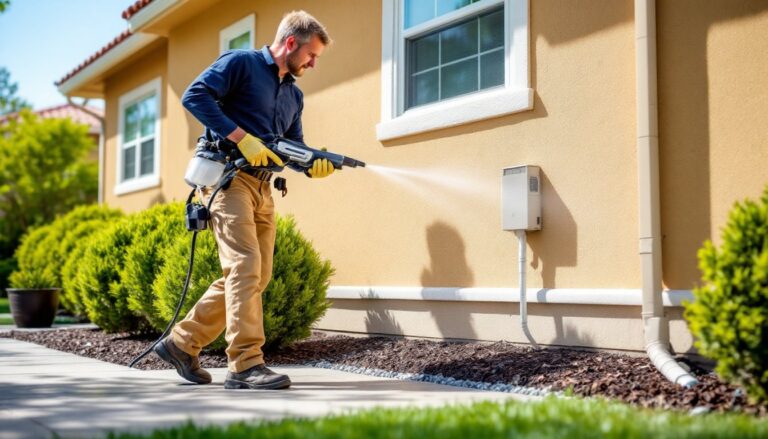
The product comes in a battery-powered spray wand format (typically 0.5 or 1.25 gallon) with a continuous spray trigger. This design eliminates manual pumping and allows for consistent application along foundation walls, door frames, and window casings. The formula dries clear and is rainfast after a few hours, which means it won’t wash away with the first shower.
Bifenthrin binds to porous surfaces like concrete, stucco, and wood siding, where it remains active for up to 12 months according to the manufacturer. That extended residual protection is what sets it apart from contact-kill sprays that only work in the moment. The chemical breaks down slowly under UV exposure, so shaded areas (like under eaves or along north-facing walls) tend to hold effectiveness longer than sun-baked zones.
Key Features and Benefits for Homeowners
Long-lasting barrier protection tops the list. A single application provides months of defense, reducing the need for weekly spot treatments. This is especially valuable for homes near wooded areas or properties with mulch beds that harbor pests.
Broad-spectrum control means one product handles multiple invaders. You’re not buying separate sprays for ants, spiders, and roaches, the bifenthrin formula targets all of them. According to pest control experts, maintaining a consistent perimeter treatment is one of the most effective preventative measures for outdoor insect problems.
Ready-to-use convenience eliminates mixing and measuring. The battery-powered wand (requires four AA batteries, not included) delivers a steady stream without hand fatigue. Coverage is roughly 1,330 square feet per gallon, which is enough to treat the perimeter of an average single-story home two to three times.
Odorless and fast-drying formulation makes it practical for high-traffic areas. You can treat a patio or deck in the morning and use it by afternoon. There’s no oily residue or lingering chemical smell that older pyrethroids were known for.
One note: this is not a repellent. Insects must contact the treated surface to be affected, so proper application technique (covered below) is critical.
How to Apply Ortho Home Defense Outdoor: Step-by-Step Instructions
Preparing Your Property for Application
Start by clearing the treatment zone. Move planters, outdoor furniture, toys, and decorative items at least 3 feet away from the foundation. You need clear access to the entire perimeter, including behind downspouts and AC condenser units.
Mow the lawn and trim back vegetation that touches the house. Overgrown shrubs, ground cover, and mulch beds should be pulled back from the foundation by 6-12 inches if possible. Bugs travel along these “highways,” and you want the chemical barrier to intercept them before they reach your walls.
Inspect for active nests or hives. If you spot a wasp nest, hornet colony, or ant mound near the treatment area, address those separately first. Ortho Home Defense Outdoor works on individual pests, not entire colonies in one shot. Remove visible spider webs with a broom, dead webbing just collects treated spray and reduces soil contact.
Check the weather. You need 24 hours without rain for optimal results (the label says rainfast in a few hours, but full curing takes longer). Wind speeds above 10 mph can cause drift, so pick a calm day. Temperature should be between 45°F and 90°F for best adhesion and effectiveness.
Application Techniques for Maximum Coverage
Shake the container thoroughly before use. Install fresh AA batteries in the wand, weak batteries cause inconsistent spray patterns. Hold the wand at a 45-degree angle pointed toward the foundation, about 12 inches away from the surface.
Apply a continuous 4-inch band along the foundation, starting at one corner and working around the entire house. Overlap slightly at corners and don’t skip areas behind bushes or stairs. Spray both the foundation wall and the soil or mulch immediately adjacent to it, this dual-zone treatment catches pests coming from either direction.
Treat door thresholds and window frames on the outside only. Focus on cracks, gaps, and weep holes where insects enter. Don’t spray window glass or painted surfaces excessively: a light pass is enough.
For decks and patios, apply along the perimeter edges and any posts or support beams that contact the ground. Avoid spraying the walking surface itself unless you’re targeting a specific infestation, the product is designed for vertical barriers, not horizontal foot traffic.
One 0.5-gallon container covers roughly 665 linear feet of 4-inch band. An average home perimeter is 150-200 linear feet, so you’ll have enough for 3-4 full treatments per bottle. Label the container with the application date so you can track reapplication intervals.
What Pests Does Ortho Home Defense Outdoor Target?
The product label lists over 130 insects, but here are the most common targets for homeowners:
• Ants (carpenter, pavement, odorous house ants): Bifenthrin disrupts their trail-following behavior and kills workers before they establish indoor colonies.
• Spiders (common house spiders, wolf spiders, brown recluse): Effective on contact, though spiders that don’t regularly walk on treated surfaces may avoid exposure.
• Roaches (American, German, Oriental): Works well on outdoor-dwelling roaches that migrate indoors seasonally.
• Earwigs, silverfish, centipedes, millipedes: These moisture-loving pests often enter through foundation cracks: perimeter treatment intercepts them.
• Crickets and grasshoppers: Seasonal invaders during late summer and fall.
• Boxelder bugs, stink bugs, cluster flies: Overwintering pests that congregate on sunny exterior walls in autumn.
It does not control termites, ticks, or fleas effectively. For termites, you need a soil-applied termiticide and often a licensed applicator. Tick and flea control requires yard-wide treatment, not just perimeter barriers. Many homeowners find inspiration for broader pest management strategies on sites like Gardenista, which covers integrated landscape and garden health approaches.
Mosquitoes are not listed, though the spray will kill them on direct contact. For mosquito control, you need a fogger or misting system that targets resting and breeding areas.
Safety Considerations and Best Practices
Always wear gloves and eye protection during application. Bifenthrin is low-toxicity for mammals when dry, but wet concentrate can irritate skin and eyes. A long-sleeve shirt and pants reduce incidental contact.
Keep people and pets off treated areas until the spray dries completely, usually 1-2 hours depending on temperature and humidity. Once dry, the treated surface is safe for normal contact. The label specifies no re-entry time for dried residue, but common sense says don’t let toddlers or pets lick foundation walls.
Do not apply near aquatic environments. Bifenthrin is highly toxic to fish and aquatic invertebrates. If your property has a pond, stream, or drainage ditch within 25 feet, maintain a buffer zone and don’t allow runoff into those areas. This is a hard rule, not a guideline.
Avoid spraying edible gardens or fruit trees. The product is labeled for ornamental plantings and lawns, not food crops. If you must treat near a vegetable bed, use a piece of cardboard as a shield to prevent drift.
Store the container in a cool, dry place away from children and pets. Don’t leave it in direct sun or in a vehicle, heat degrades the active ingredient. Dispose of empty containers per local hazardous waste guidelines: many municipalities have annual collection events.
One final point: this is a cosmetic and preventative treatment, not structural pest control. If you have a serious infestation (carpenter ant damage, recurring termite swarms, rodent entry points), call a licensed pest control professional. Ortho Home Defense Outdoor handles the routine invaders: it’s not a substitute for targeted intervention. For comprehensive home maintenance and care tips that go beyond pest control, The Spruce offers detailed guides on keeping your home in top shape year-round.